Android-OCR: On-Device OCR for Android PDAs
A barcode scanner beeps all day — and reads nothing but barcodes. Ask it for the...
 HappyLab shared on Sep 13, 2026HappyLabshared on Sep 13, 2026
Three products, three launches:
They look like three independent products. Open them up, though, and something interesting shows: they share the same OCR framework. It is not that three products look alike — it is one technology stack fitted into three hardware shells.
This is that framework, explained.
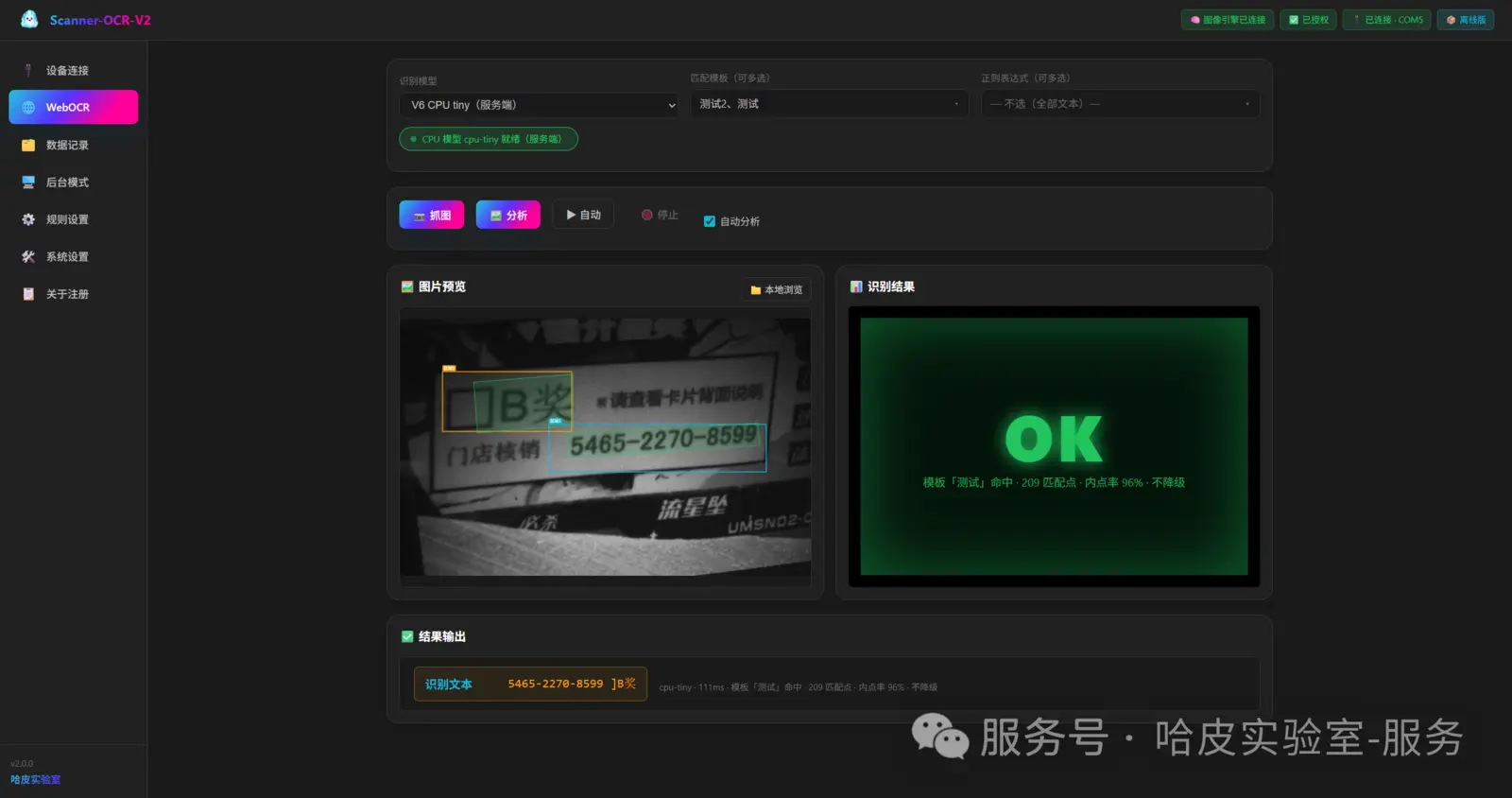
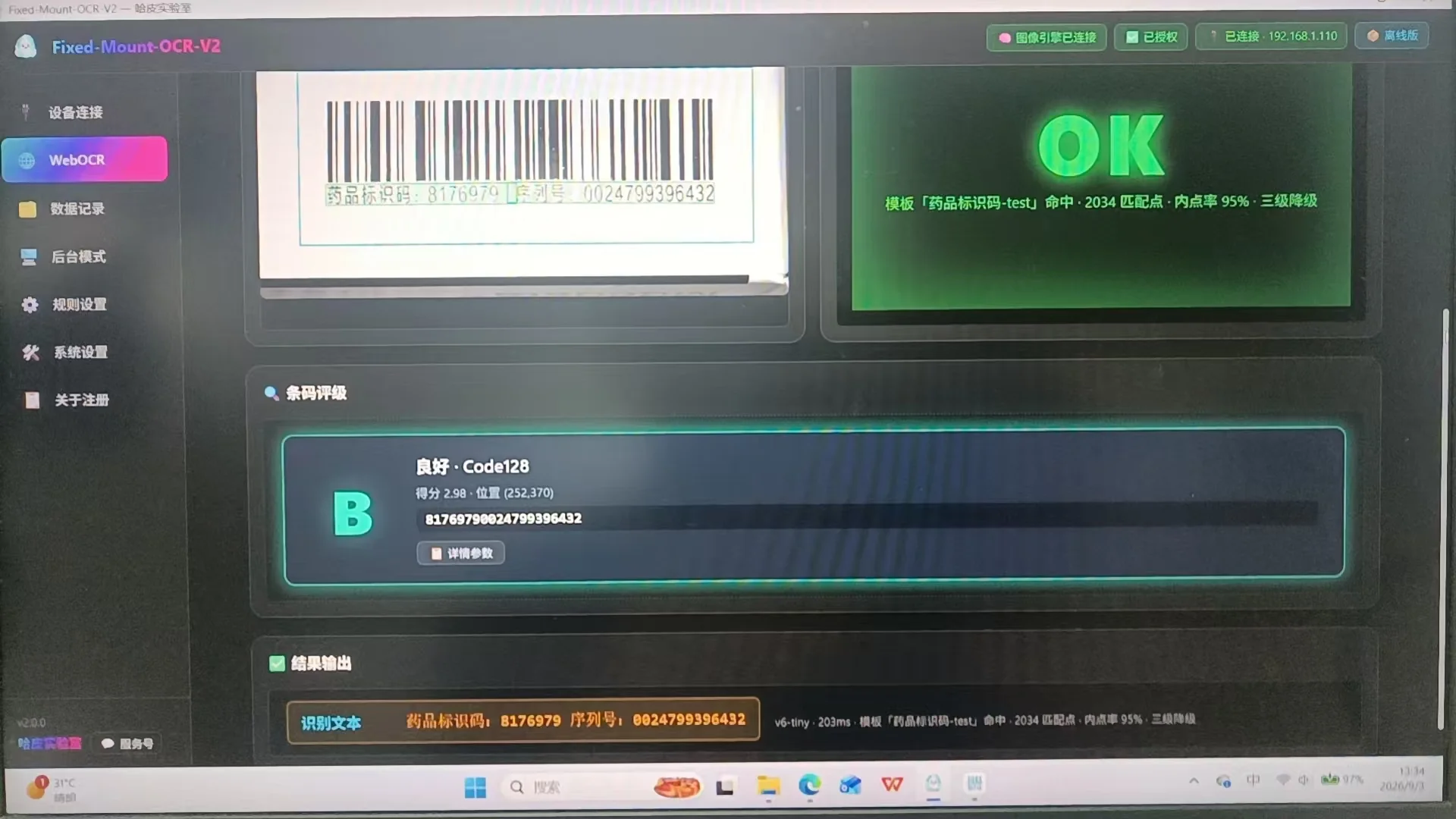
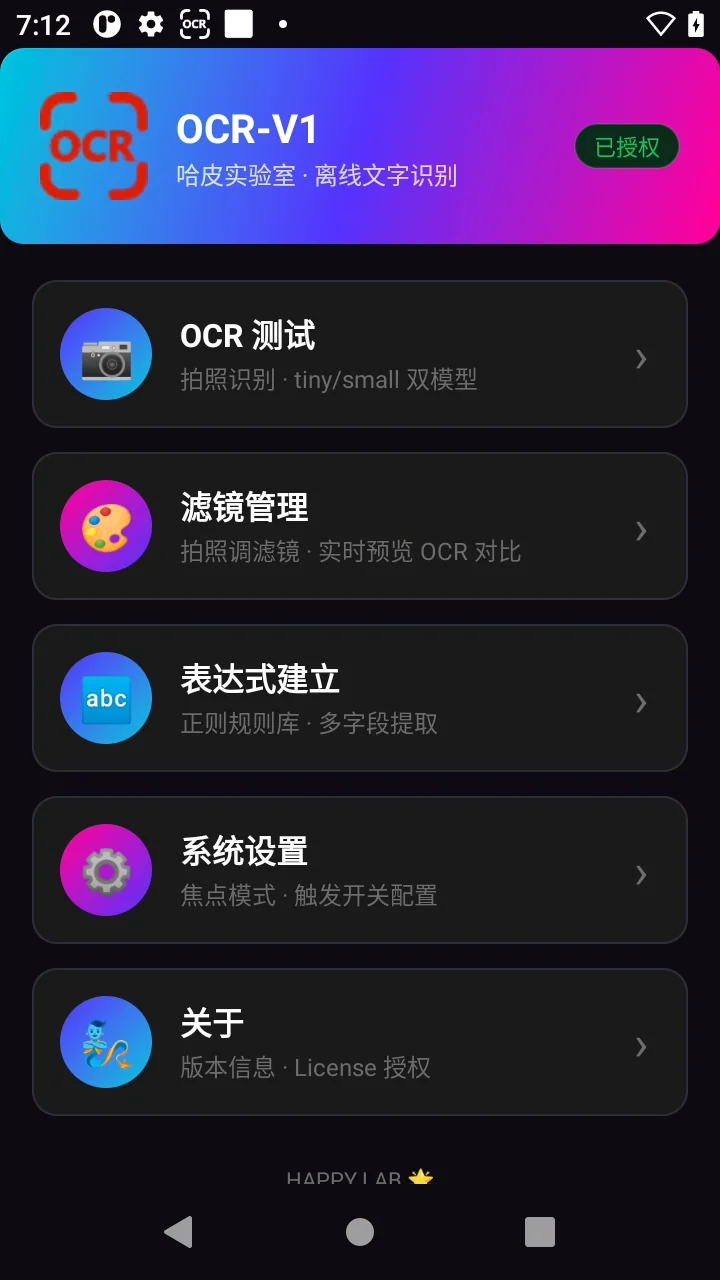
| Product line | Form | Capture the image from | Core capability |
|---|---|---|---|
| 🔫 Scanner OCR | Desktop app (single .exe) | Brady IPS scanner over USB | Trigger pull → recognise → focus entry |
| 📦 Fixed-Mount OCR | Industrial-PC software | Brady IPS fixed-mount reader, image pushed over FTP | OCR content + barcode grading |
| 📱 Android OCR | Android app (.apk) | PDA camera or scan engine | Scan key / broadcast / floating ball → focus injection |
Whatever device a customer has on the line, there is a matching form factor.
Stack the three products and the same five-layer core emerges:
1 | ┌─────────────────────────────────────────────────────┐ |
Only the bottom layer — Capture — changes with the hardware. The four layers above it (Vision, Engine, Rules, Output) are shared across all three lines. Adding a new device means writing a capture adapter; nothing above it moves.
Because the core is shared, any improvement at any layer reaches all three product lines at the same time:
| Capability | Scanner | Fixed-Mount | Android | Notes |
|---|---|---|---|---|
| OCRv6 engine (tiny / small) | ✅ | ✅ | ✅ | Same models, same pre/post-processing |
| 15-filter pre-processing | ✅ | ✅ | ✅ | Handles dark, colour-cast and shadowed captures |
| Feature-template ROI | ✅ | ✅ | — | Boxed on desktop; Android uses the framing guide |
| Regex field extraction | ✅ | ✅ | ✅ | Rules export/import as JSON across form factors |
| Fully offline inference | ✅ | ✅ | ✅ | Nothing leaves the plant or the device |
| Focus output | ✅ | ✅ | ✅ (accessibility) | Results go straight into the business app |
| Record logging | ✅ | ✅ | 🚧 | Android logging is planned |
| Barcode grading | — | ✅ | — | Fixed-mount only: content and quality from one scan |
The real value of “one architecture” is not the development saved — it is that:
Capability is no longer “one copy per product”. It is one capability pool, drawn on by all three.
The core is shared, but each line pushes its own part to the limit.
{barcode}-{timestamp}-OK/NG), so that field comes at no extra cost.A customer site may have scanners, fixed-mount readers and PDAs all at once. The traditional answer is one system per site: three codebases, three maintenance tracks, three upgrade paths.
With a single core:
1 | One OCR framework |
The three lines are the present. The framework’s real ambition is a smooth path to the next generation of AI-compute handhelds.
A modern Android AI chip is a heterogeneous platform: a CPU for general logic and scheduling, a GPU for graphics and parallel work, an NPU for neural-network acceleration, an ISP for the capture path, and a DSP for signal processing and always-on low-power tasks.
| Characteristic | What it means for OCR |
|---|---|
| MAC arrays for matrix/convolution work | Detector and recogniser inference speeds up sharply |
| INT8 / INT4 quantisation | A 6 MB tiny model fits and runs efficiently |
| High performance per watt | Battery life holds; the device runs all day |
| On-chip inference | Data never leaves the device — offline by default |
Android OCR runs a standard ONNX model on a standard Android inference stack — that choice is deliberate:
1 | Today Tomorrow |
Recognition capability should not be frozen at the moment of purchase. Building the foundation at the software layer is what lets every hardware generation move all three product lines forward.
Three products, three launches — and under the hood, one engine.
They share the same Vision, Engine, Rules and Output capabilities, and adapt upward to different hardware, scenarios and systems: one framework, three product lines, upgrades shared across all of them.
| Product | From |
|---|---|
| Scanner OCR V2 | $180 per scanner |
| Fixed-Mount OCR V2 | $680 |
| Android OCR | $199 |
All licenses are one-time — no subscriptions. Full comparison on the pricing page.
This global site is brand new, and our online tools are currently in Chinese. Tell us what you need and we’ll set up a fast, tailored solution for you — an English version is coming in the next few weeks.
📧 sales@happylab.me · 🌐 global.happylab.me
HappyLab builds practical AI and browser-based tools for industrial device workflows.
Next
A barcode scanner beeps all day — and reads nothing but barcodes. Ask it for the...
HappyLab shared on Sep 13, 2026