Fixed-Mount OCR V2: Read Characters and Grade Barcode Quality on the Line
A fixed-mount reader has seen more than its share of barcodes pretending to be f...
 HappyLab shared on Sep 2, 2026HappyLabshared on Aug 28, 2026
A barcode that scans is not a barcode that passes.
Skewed, faded or smudged codes scan today and fail tomorrow — and the failure shows up as a stopped line, a returned shipment or a compliance finding, all traced back to a code that looked fine. The problem is that “it scans” is a probability, not a guarantee. Ribbon ageing, printhead wear, moisture and handling all erode quality gradually, and the erosion is invisible to a spot check by eye.
The professional answer is not “scan it and see”. It is to grade the code against the ISO standard and find the problem while it can still be read.
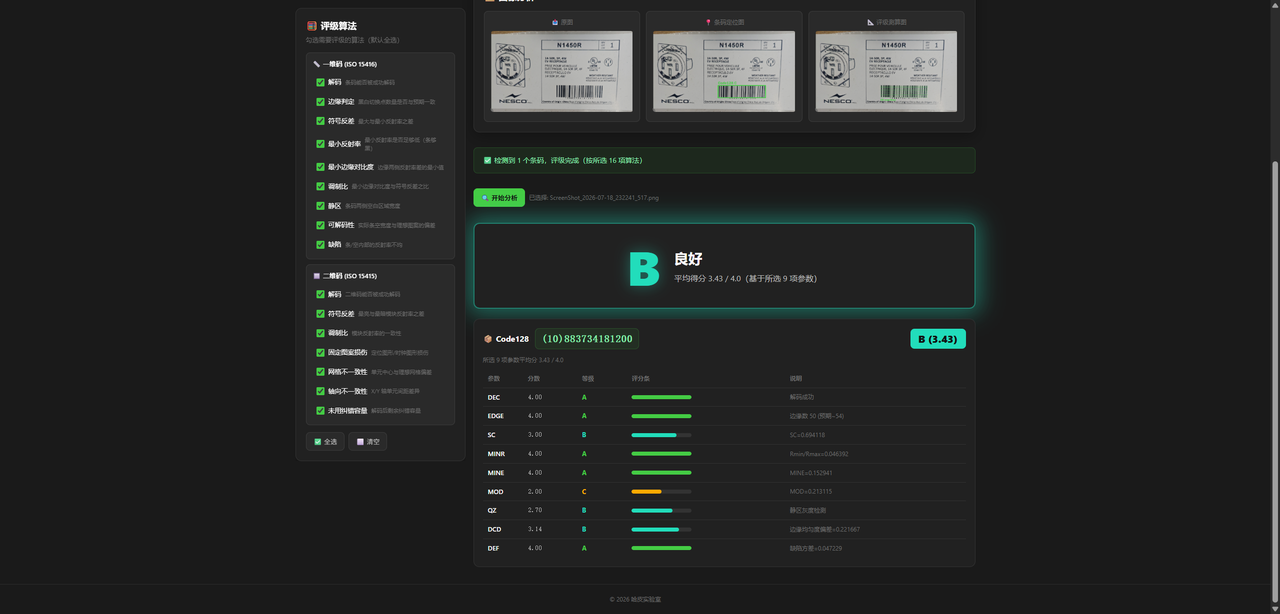
HappyLab’s barcode quality grading engine does exactly that — in software. Upload a label, get a 1D or 2D report with a per-parameter breakdown and an overall A–F grade in seconds.
TIP
New global site. The tool interface is currently in Chinese while we finish the English build — it ships in October 2026. The grading engine itself is language-independent; tell us what you need and we’ll help you test it: sales@happylab.me.
ISO defines two core methods for print quality:
| Standard | Applies to | Method |
|---|---|---|
| ISO/IEC 15416 | 1D codes (Code 128 / 39 / 93, EAN/UPC, ITF…) | 10 scan lines, 9 parameters |
| ISO/IEC 15415 | 2D codes (QR, DataMatrix, Aztec…) | Module-grid rebuild, 8 parameters |
| ISO/IEC 29158 | 2D DPM marks (laser, dot-peen) | Multi-angle lighting, same parameters |
Scores run from 0 to 4.0 and map to six grades:
| Score | Grade | Meaning |
|---|---|---|
| 3.5 – 4.0 | A | Excellent |
| 2.5 – 3.5 | B | Good |
| 1.5 – 2.5 | C | Pass |
| 0.5 – 1.5 | D | Poor |
| 0 – 0.5 | F | Fail |
The overall grade is the worst single parameter — the weakest-link rule. One parameter out of spec (an occupied quiet zone, weak contrast) puts the whole code at risk. That is why a code can scan perfectly today and be graded D.
For a 1D code, the nine parameters are: decode, edge determination, symbol contrast, minimum reflectance, minimum edge contrast, modulation, quiet zone, decodability and defects. None of this is guesswork — it is a quantified, repeatable measurement.
Commercial verifiers from Cognex, Keyence and Axicon are integrated units: industrial camera, standardised lighting, calibrated optics and dedicated software, typically costing tens of thousands. HappyLab took a different route — implementing the grading algorithms in software, so any computer can run them.
1 | Label image in |
What makes the engine notable:
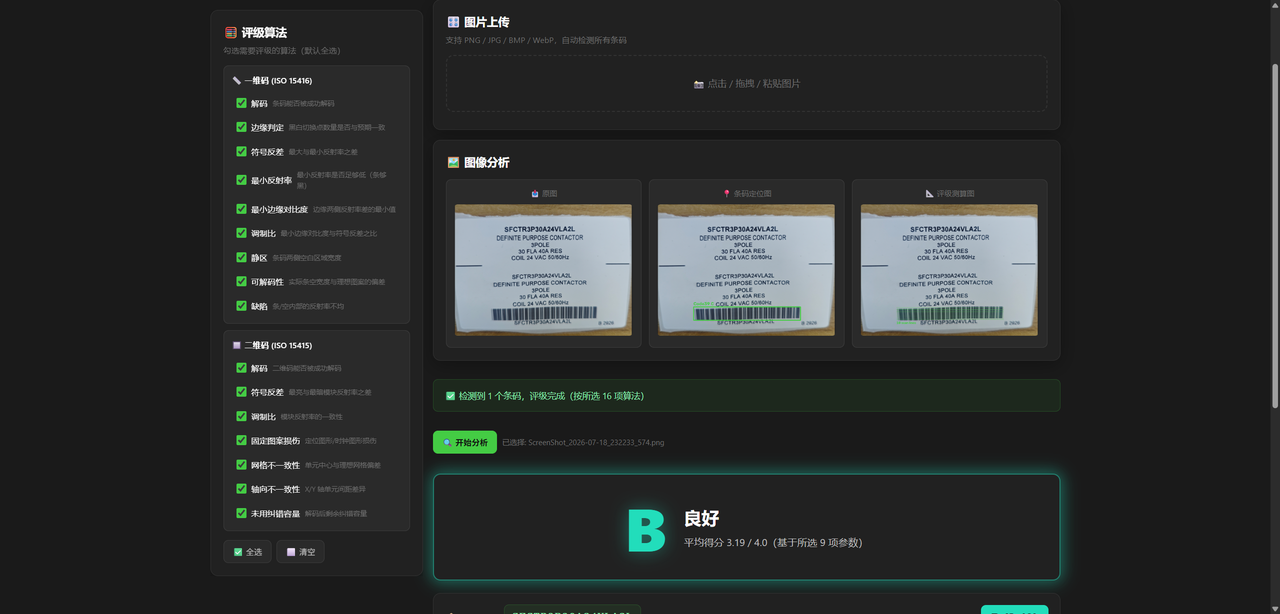
Print several hundred labels and a visual spot check will not reveal ribbon ageing or printhead wear. Put a laptop or phone beside the printer, photograph one or two labels per batch and grade them: under a minute per check, and a trend line that shows quality declining before a customer finds it.
A fixed-mount reader can hand every captured image to the grading engine. A code that scans but grades C, D or F is a warning: check the print parameters. Aggregate grades per station and you can locate the source of the drift, not just the symptom.
Supplier labels vary in quality, and warehouse sampling by eye is not a standard. Photograph, grade and record — one consistent criterion, with an archived report to point to if there is a dispute.
Where quality is mandatory, sending every sample to a professional verifier is slow and costly. Screen internally first and send only what clears your threshold — turning a pass rate based on luck into something closer to a certainty.
This is the part we most want to be clear about.
Why commercial verifiers cost what they do. ISO-compliant grading depends not only on the algorithm but on standardised hardware: 45° ring illumination at 660 nm with ±10% uniformity and ambient-light shielding, a standard aperture (0.25 mm by default, chosen by density), periodic calibration against a reflectance reference, a camera of ≥5 megapixels shooting perpendicular within 15°, and a formal three-part report format (grade/aperture/wavelength, e.g. 3.0/06/660). The cost is in meeting those specifications and carrying the certification — not in the software.
| Commercial verifier | HappyLab software | |
|---|---|---|
| Hardware cost | Tens of thousands | Software only |
| Deployment | Fixed station, trained operator | Any PC or phone; upload and go |
| Throughput | One code at a time | Batch images, instant reports |
| Certification | ✅ ISO-compliant | ⚠️ Reference-grade; no ISO certification claimed |
| Purpose | Compliance audit, certification reports | Trend monitoring, fast pass/fail screening, diagnosis |
Please read: reference-grade is not certification
This system is a reference-grade grader. It does not claim ISO certification and must not be used as a formal compliance audit report. ISO-compliant grading requires standardised hardware — controlled 45° / 660 nm lighting, a standard aperture, a calibrated reflectance target — which is exactly what commercial verifiers provide.
Our value is different: making everyday quality control available to everyone. Certification stays with dedicated equipment.
What we lack is the standardised light source, aperture and calibration target — those are hardware, not algorithms. But “reference-grade” is a long way from “not useful”:
We are not trying to replace a professional verifier. We are making it possible for anyone with a computer to screen first.
The engine ships as a standalone product, and it is built to be integrated:
An offline, API-accessible grader is what makes this usable in plants where sending label images to a cloud service is simply not an option.
| 🔍 Standalone | 🛠️ Custom integration | |
|---|---|---|
| Price | $300 one-time | from $200 |
| Runs offline | ✅ | ✅ |
| API access | ✅ | ✅ |
| Batch grading | ✅ | ✅ |
| Output format | Standard report | Adapted to your system |
All licenses are one-time — no subscriptions, nothing to renew. Full details on the barcode grading pricing page.
Need it wired into your MES/ERP, a different report format, or an on-premise deployment? Custom work starts at $200, depending on the requirement. Tell us what you need.
Try the grader on your own labels for 30 days, free — or start with the online tool and upload an image right now, no signup required.
This global site is brand new, and our online tools are currently in Chinese. Tell us what you need and we’ll set up a fast, tailored solution for you — an English version is coming in the next few weeks.
📧 sales@happylab.me · 🌐 global.happylab.me
HappyLab builds practical AI and browser-based tools for industrial device workflows.
Previous

A fixed-mount reader has seen more than its share of barcodes pretending to be f...
HappyLab shared on Sep 2, 2026Next
A barcode scanner has spent decades doing one thing perfectly: beep, and the val...
HappyLab shared on Aug 12, 2026